
Santo Domingo
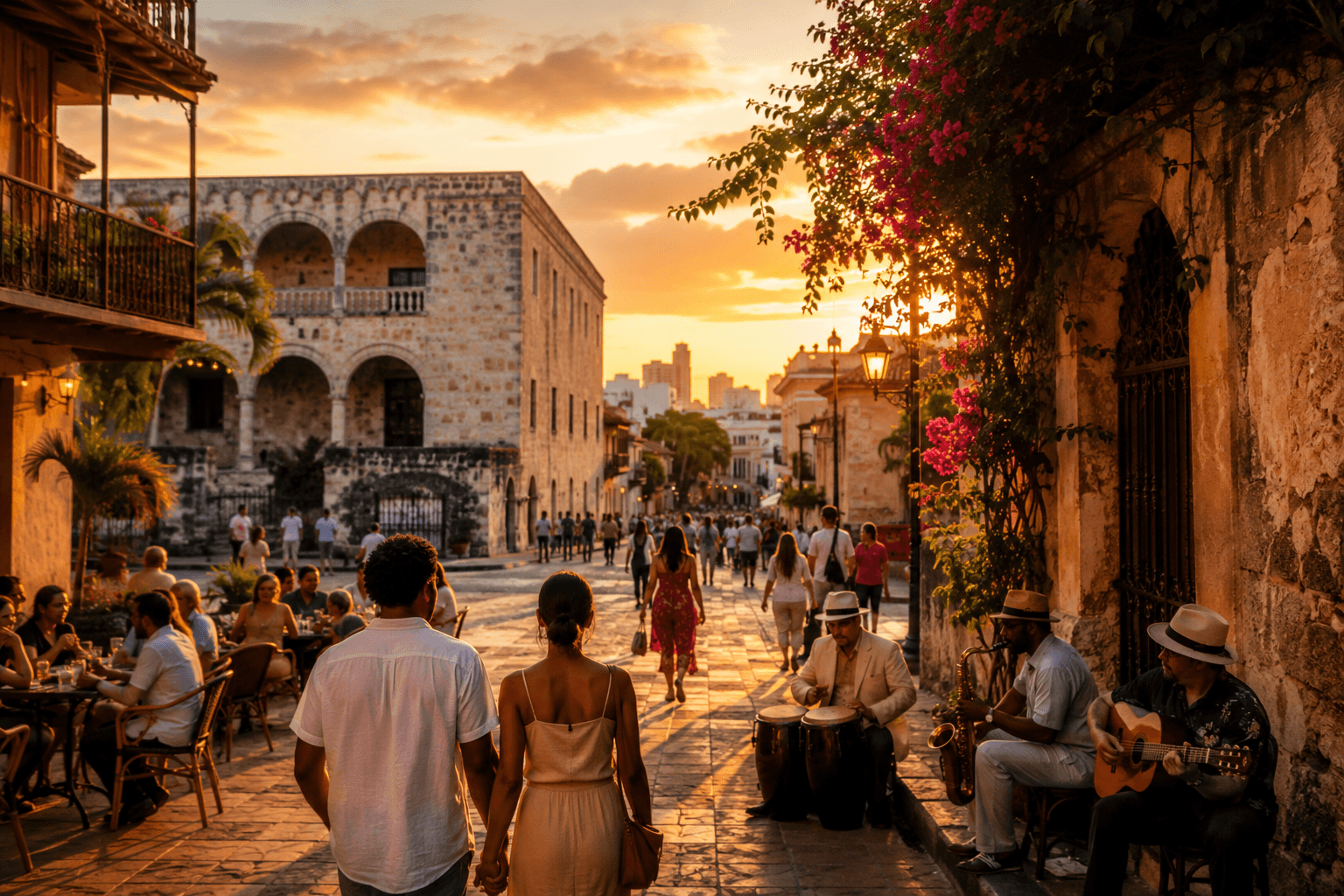
Temporary WSD editorial visualization of Santo Domingo's history, street life, and music. · WSD AI-generated editorial artwork; not documentary photography.
Geography and orientation
Santo Domingo is easiest to understand when you separate the legal capital from the wider metropolis. Santo Domingo de Guzmán, the national capital, is the Distrito Nacional. Across and around it, municipalities such as Santo Domingo Este, Santo Domingo Norte and Santo Domingo Oeste belong to the separate Provincia Santo Domingo. WSD uses “Greater Santo Domingo” only when the visitor experience genuinely crosses those administrative boundaries.
That distinction matters because several places commonly marketed as “Santo Domingo” sit outside the Distrito Nacional. Los Tres Ojos and the Faro a Colón are in Santo Domingo Este, while Las Américas International Airport lies farther east in the airport corridor. A good visit can cross the metropolitan area, but the guide should not pretend every stop is one downtown neighborhood.
Why go
Come for the history, but stay for the living capital. Santo Domingo is where WSD can connect early Caribbean urban history with contemporary Dominican food, music, museums, baseball, public space and the daily energy of the country’s largest metropolitan area.
It is also the Dominican Republic’s strongest city-break destination for travelers who want more than a resort: a walkable historic core, serious cultural institutions, modern dining districts and enough variety to justify several nights rather than a one-night airport stop.
Areas and neighborhoods
Ciudad Colonial
The UNESCO-inscribed historic core and the strongest base for a first cultural visit: plazas, early colonial architecture, museums, restaurants and a compact street network.
Best explored on foot in sections; current monument access should be checked before a tightly timed museum day.
Gazcue
A historic residential and institutional transition zone between the Colonial City, central avenues and the Malecón, with a more everyday urban feel than the tourist core.
Useful for travelers who want central access without staying inside the busiest historic streets.
Malecón / Avenida George Washington
The Caribbean waterfront edge of the capital, combining sea views, hotels, public space, recreation and a long urban promenade.
Treat it as a long corridor rather than one compact attraction; walking comfort varies by segment and time of day.
Piantini, Naco & Polígono Central
Modern Santo Domingo: restaurants, shopping, business hotels and contemporary city life around major avenues including Winston Churchill and Gustavo Mejía Ricart.
A strong base for dining and modern-city access; less useful if your priority is stepping directly into the Colonial City each morning.
Plaza de la Cultura
The capital’s major institutional culture zone, with national museums and performing-arts institutions that add depth beyond the Colonial City.
Choose specific institutions rather than assuming every museum can be covered in one rushed stop.
Mirador Sur
A greener western part of the Distrito Nacional centered on one of the city’s major parks and a more residential urban rhythm.
Best treated as part of a broader modern-city day rather than a substitute for the historic core.
Santo Domingo Este
A separate municipality east of the Ozama with major visitor sites including Los Tres Ojos and other metropolitan attractions. It is part of Greater Santo Domingo, not a neighborhood of the Distrito Nacional.
Plan transport deliberately; staying here creates a different trip from staying in the Colonial City or central Distrito Nacional.
Essential experiences
Walk the Colonial City with context
Use Parque Colón, Calle Las Damas, the Cathedral area, Fortaleza Ozama, Plaza España and the Alcázar de Colón as a connected urban story rather than a checklist of “firsts.” The district is a living neighborhood as well as a World Heritage site.
Allow time to walk, sit in the plazas and enter only the museums or monuments that genuinely interest you.
Choose at least one serious museum or cultural institution
Santo Domingo’s story becomes much richer when the trip includes a museum, archive, visual-arts space or performing-arts institution rather than relying only on outdoor monuments.
Verify current opening days and any renovation impacts before building a schedule around one institution.
See the city from the Caribbean waterfront
The Malecón gives Santo Domingo a different scale: sea, traffic, public space, hotels, recreation and an urban edge that contrasts sharply with the enclosed streets of the Colonial City.
Pick a specific segment and time rather than expecting the full avenue to function like one continuous pedestrian attraction.
Spend time in modern Santo Domingo
Piantini, Naco and the Polígono Central reveal the contemporary capital through restaurants, shopping, business activity and evening social life. This is essential to understanding Santo Domingo as more than a heritage district.
Keep named restaurant and nightlife recommendations in freshness-sensitive Food and Nightlife coverage.
Cross into Santo Domingo Este for Los Tres Ojos
The cave-and-lagoon landscape of Los Tres Ojos provides a dramatic nature break close to the urban core and makes the metropolitan geography visible: this major attraction is east of the Ozama, outside the Distrito Nacional.
Treat it as a deliberate cross-city outing and verify current access details before departure.
Make room for living culture
Depending on the calendar, Santo Domingo can add live Dominican music, baseball, theater, festivals or other public cultural programming to the trip. The point is not one guaranteed event; it is to experience the capital as a place where Dominican culture is still being made.
Schedules are volatile. Verify the exact event, venue and ticket/access rules close to the visit.
Culture and history
The Colonial City is one of Santo Domingo’s defining reasons to visit, but the history should not be told as a triumphal list of Spanish “firsts.” UNESCO’s inscription documents the city’s early colonial institutions and influence on urban planning in the Americas, while also describing a place where Indigenous, European and African histories intersected.
The chronology itself needs care. The settlement was established on the east side of the Ozama in the late 1490s, and in 1502 Nicolás de Ovando transferred its institutions to the west bank and imposed the grid that shaped the historic center. That distinction is more useful than compressing several events into one simplistic founding date.
A complete Santo Domingo story also reaches far beyond the sixteenth century. Independence politics, the Trujillo dictatorship, the 1965 civil war and U.S. intervention, migration, popular music, baseball and the growth of the modern capital all left physical and cultural traces in the city.
WSD should therefore treat the Colonial City as a starting point, not the end of the narrative. The visitor who sees only stone façades misses the capital where contemporary Dominican identity, commerce, art, sport and politics continue to collide.
Food
Santo Domingo is the country’s strongest cosmopolitan dining market with Dominican foundations. Traditional Dominican cooking sits beside contemporary local chefs, international restaurants, cafeterías, comedores, bakeries, street food and polished dining rooms.
The geography of eating helps explain the city. The Colonial City mixes visitor-facing restaurants with cafés and bars; the Malecón adds a waterfront context; and Piantini, Naco and the wider Polígono Central concentrate a large share of the modern restaurant scene.
Do not look for one dish that supposedly “belongs” to Santo Domingo. A better approach is to use the capital to compare everyday Dominican sazón and lunch culture with newer interpretations of local ingredients and the international influences of a large Caribbean city.
Named restaurant recommendations should live in freshness-sensitive Food coverage. Santo Domingo changes too quickly for an evergreen destination guide to freeze a list of venues and pretend it will remain accurate.
Where to base yourself
Ciudad Colonial — best for a first cultural trip
Stay here if you want historic streets, plazas and major monuments at the door and expect to spend a large part of the trip walking. It offers the strongest immediate sense of place, but it is not the most convenient base for every modern-city stop.
Gazcue / Malecón — best for a mixed central stay
This zone works well when you want easier access to the waterfront and a more mixed residential/urban setting while remaining close to the historic core.
Piantini / Naco / Polígono Central — best for modern dining and city life
Choose this side of the capital if restaurants, shopping, business hotels and contemporary nightlife matter more than waking up inside the Colonial City.
Santo Domingo Este — choose it intentionally
It can make sense for specific eastern-metro plans, but it is a different base from the historic center. Do not book there assuming every place labeled “Santo Domingo” is equally close to the Colonial City.
Getting there
Las Américas International Airport (SDQ) is the principal international gateway for the capital. It sits east of the Distrito Nacional in the Santo Domingo Province airport corridor, so an airport arrival is already a lesson in the difference between the legal capital and Greater Santo Domingo.
Build transfer time into the first and last day rather than treating SDQ as a downtown airport. The terminal complex remains operational while a major new terminal is being built in phases, so travelers should use current airline and airport information for check-in location, construction impacts and departure timing.
Getting around
Santo Domingo is not one walkable district. The Colonial City is the easiest area to explore on foot, while trips between the historic center, Polígono Central, Plaza de la Cultura, Mirador Sur and Santo Domingo Este usually require motorized transport.
The Metro is useful for parts of the metropolitan area and expanded westward with Line 2C in 2026. It should be treated as part of the city’s transport system, not as a door-to-door tourist solution for every attraction.
For a first visit, think in clusters: walk within the Colonial City, group modern-city stops together, and plan eastern-metro attractions such as Los Tres Ojos as a separate movement across the city. Verify current public-transport hours and fares if your itinerary depends on them.
When to go
Santo Domingo works year-round because much of its value is urban: museums, food, architecture, music and neighborhood life do not depend on a beach season.
Weather still matters. Heat, heavy rain and the Atlantic hurricane season can change how much time you want outdoors, while cultural festivals, baseball and other events can make certain periods especially rewarding.
Instead of treating one four-month window as universally “best,” choose dates around the kind of trip you want and check the current weather outlook and event calendar shortly before travel.
Suggested trip length
2 nights — a fast introduction
Enough for a focused Colonial City day plus a taste of the modern capital, but you will have to choose museums, food and evening experiences carefully.
3–4 nights — the strongest first visit
Gives you room for the historic core, at least one serious cultural institution, modern neighborhoods, food, the Malecón and an eastern-metro stop such as Los Tres Ojos without turning the trip into a race.
4–5 nights — a deeper capital trip
Best if Santo Domingo itself is the destination rather than a stopover. Add more museums, neighborhood time, sport or performance, and a nearby excursion while leaving space for the city to feel unscheduled.
Nearby excursions
Boca Chica can provide a beach contrast east of the capital, but it is a separate municipality and should be framed as an excursion rather than “Santo Domingo beach.”
Longer day trips toward San Pedro de Macorís, Baní/Peravia or other regions should be attached only when WSD has a substantive destination or story that explains why to go; this hub should not become a dumping ground for every attraction within driving distance.
Current notes
Frequently asked questions
What is Santo Domingo known for?
Santo Domingo is best known for its UNESCO-listed Colonial City, but the capital is much more than historic architecture. It is also the country’s leading urban center for museums, dining, music, business, nightlife, baseball and contemporary Dominican culture, with a Caribbean waterfront and a metropolitan area that extends beyond the Distrito Nacional.
How many days do you need in Santo Domingo?
Three to four nights is the strongest first visit for most travelers. That gives you time for the Colonial City, at least one museum, modern neighborhoods, food, the Malecón and an eastern-metro attraction such as Los Tres Ojos. Two nights works for a fast introduction; four to five supports a deeper city trip.
What is the best area to stay in Santo Domingo?
There is no single best area. Ciudad Colonial is strongest for first-time culture and walking; Gazcue and the Malecón suit a mixed central stay; Piantini, Naco and the Polígono Central are better for modern dining, shopping and business. Santo Domingo Este should be chosen intentionally because it creates a different geography.
Is Santo Domingo’s Colonial City walkable?
Yes. The Colonial City is the easiest part of Santo Domingo to explore on foot, and many major plazas, streets and monuments are close together. The wider capital is not one walkable district, however, so plan transport for modern neighborhoods, Mirador Sur, Plaza de la Cultura and attractions in Santo Domingo Este.
Is Santo Domingo safe for visitors?
Santo Domingo is a major city, so risk varies by place and time rather than fitting a simple yes-or-no label. Current government travel advisories flag crime and recommend heightened caution. Stay aware of your surroundings, avoid displaying valuables, use sensible transport choices after dark and review current official advice before your trip.